Startup Guides
Why Your MVP Needs a Kill Switch — And How to Set One Before You Launch
Every MVP needs failure criteria before launch. Without a kill switch, founders waste years on dead products. Here's the framework to set yours.
There's a specific type of startup hell that nobody warns you about before you launch. It's not the dramatic crash-and-burn that makes for good startup podcasts. It's quieter and more insidious: the zombie product. You have users — not enough. You have revenue — not growing. You have a product — not really working. And every week, you tell yourself it's about to turn a corner. Six months pass. Then a year. You've burned through runway, burned out your team, and built something that's going nowhere — but you don't know how to stop.
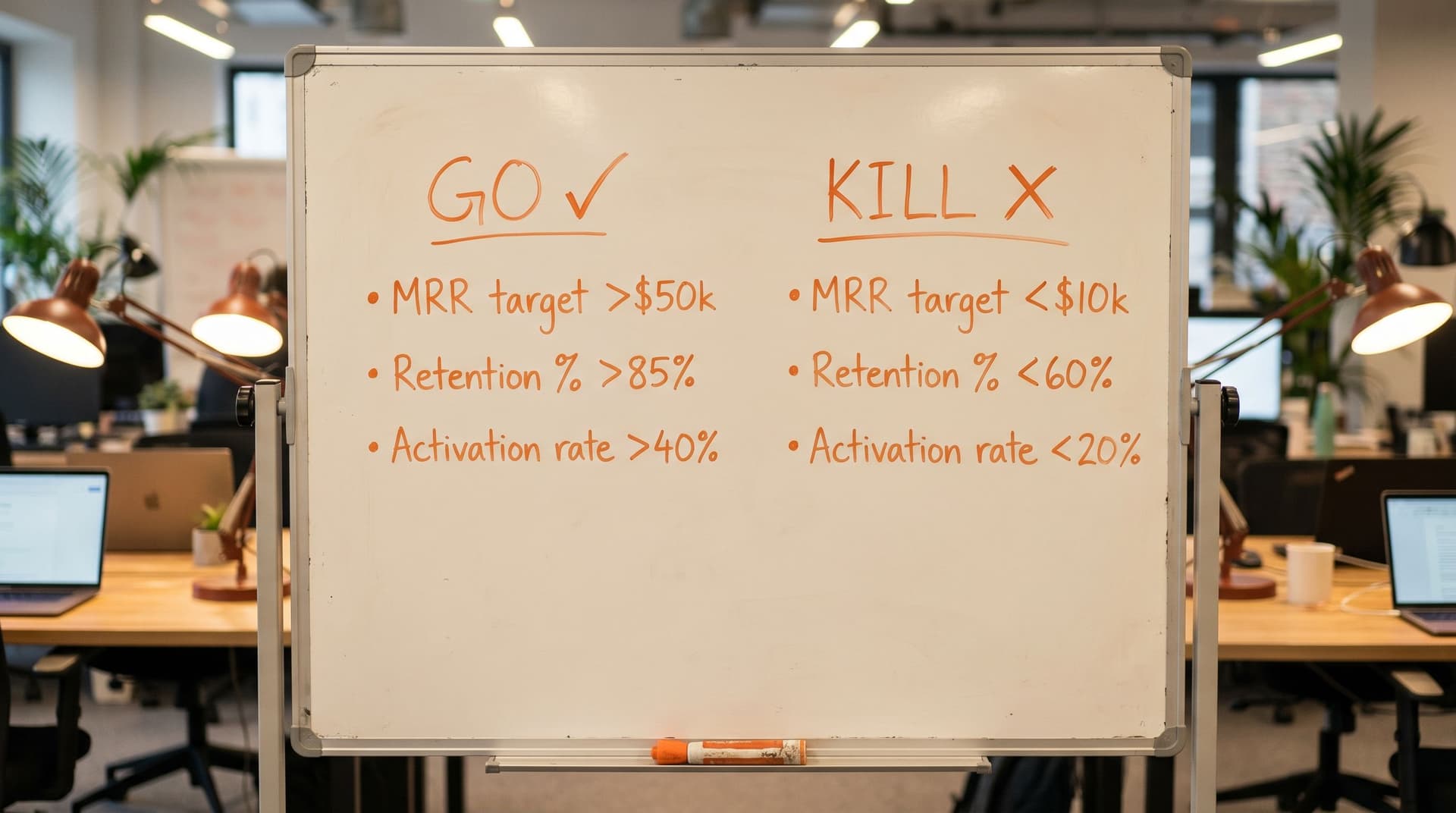
The kill switch is the tool that prevents this. It's a framework you build before launch — when you're clear-headed and rational — that defines exactly what failure looks like, and commits you to acting on it. This post covers what a kill switch is, why it works psychologically, how to set one up with real metric benchmarks, and what to do when you hit it.
Why Founders Don't Stop When They Should
Before we talk about the framework, it's worth understanding why smart founders stay with failing products far longer than they should. It's not stupidity. It's a predictable set of cognitive biases that affect everyone.
- Sunk cost fallacy: 'I've invested 9 months in this — I can't walk away now.' The 9 months are gone regardless of what you do next. The only question is what to do with the next 9 months.
- Optimism bias: Founders are disproportionately optimistic by nature — it's often what makes them start companies in the first place. But this same optimism causes them to consistently overestimate how close a breakthrough is.
- Social identity fusion: After 6–12 months, many founders stop seeing the product as something they're building and start seeing it as an extension of who they are. Shutting it down feels like personal failure, not a strategic pivot.
- Survivorship bias pressure: The startup ecosystem is full of stories about founders who almost quit but didn't — and then made it big. This creates a perverse incentive to keep going even when the signals are clearly negative, because 'what if this is my almost-quit moment?'
- Moving goalposts: Without predefined success criteria, every missed milestone just gets replaced with a new, slightly lower one. 'We didn't hit $10K MRR this month, but if we hit $7K by next quarter...' This can continue indefinitely.
The kill switch short-circuits all of these. When you define failure criteria before launch — before you're emotionally invested, before the sunk cost accumulates, before the social pressure builds — you create a commitment device that future-you can actually follow.
What a Kill Switch Is (and Isn't)
A kill switch is a predefined, written set of metric thresholds that, if not achieved by a specific date, automatically trigger a predetermined decision — to pivot, to shut down, or to fundamentally restructure the product. Three things make it work:
- It must be written down before launch — not assembled from memory months later
- It must be shared with someone else (co-founder, investor, advisor, or even a founder community) to create external accountability
- It must include a specific date, not just a metric threshold — 'if we don't hit $5K MRR' is weaker than 'if we don't hit $5K MRR by September 1st'
A kill switch is NOT a rigid contract that ignores all context. If you're 3 days from your kill date and you just signed a contract with a Fortune 500 company, you don't pull the switch. But that exception should be a genuine fundamental change in signal — not a rounding error dressed up as a breakthrough.
The 5 Metrics to Set Before You Launch
These are the five kill switch metrics that matter most for an early-stage SaaS or digital product MVP. Set all five. Write them down. Put a date on each.
- Metric 1 — Revenue Threshold (the most important one): Define the minimum MRR you need to hit by a specific date to continue. For a bootstrapped SaaS, a reasonable benchmark is $3,000–$5,000 MRR within 90 days of first paying customer. Below that at 90 days signals either a pricing problem, a market size problem, or a product-market fit problem — all of which require a fundamental rethink, not more execution.
- Metric 2 — Activation Rate: What percentage of new signups use your core feature within their first 7 days? Benchmark: 30–40% for a well-designed product. Below 20% consistently means either the onboarding is broken, the value proposition isn't landing, or the product doesn't deliver on its promise quickly enough. Define your threshold: 'If Week 1 activation is below 25% by the end of Month 2, we redesign the onboarding or pivot the core workflow.'
- Metric 3 — Week 4 Retention: What percentage of users who activated in Week 1 are still active 4 weeks later? Benchmark: 25–35% for a B2B SaaS with weekly use cases, 15–25% for monthly use case products. Below 15% at Week 4 is a strong signal that the product isn't solving the problem well enough to become a habit. Define your threshold before launch.
- Metric 4 — The Sean Ellis PMF Score: Survey your active users with one question: 'How would you feel if you could no longer use [product]?' Options: Very disappointed / Somewhat disappointed / Not disappointed. You want 40%+ saying 'Very disappointed.' Below 40% means you don't have product-market fit yet. You can run this survey at any point post-launch with a sample of 30+ active users.
- Metric 5 — Net Promoter or Referral Signal: Are any of your customers referring others without being asked? In a healthy early-stage product, you should see at least 20% of new customers coming from word-of-mouth or referrals by Month 3. Zero organic referrals after 90 days is a meaningful negative signal — it means your customers aren't experiencing the product as genuinely remarkable.
The Kill Switch Template (Copy This)
Here is a ready-to-use kill switch template. Fill it out, share it with one other person, and commit to reviewing it on the date you set.
- Product name and launch date: [Fill in]
- Kill switch review date: [Launch date + 90 days]
- Revenue threshold: If MRR is below $_____ by [date], we [pivot pricing / pivot ICP / shut down]
- Activation threshold: If Week 1 activation rate is below ___% by [date], we [redesign onboarding / redefine core value prop]
- Retention threshold: If Week 4 retention is below ___% by [date], we [rebuild core feature / run 10 churn interviews]
- PMF score threshold: If Sean Ellis score is below 40% with 30+ respondents by [date], we [conduct 20 deep customer interviews before any new feature work]
- Referral threshold: If zero organic referrals have occurred by [date], we [run a referral incentive experiment or revisit ICP]
- Committed to by: [Your name + co-founder/advisor name]
What Happens When You Pull the Switch
Pulling the kill switch is not the end of the story — it's a decision point. There are three paths forward, and which one you take depends on what you learned during the kill switch window.
- Path 1 — The Adjacent Pivot: You have paying customers, but not enough. Your product is solving a real problem, but either for the wrong customer segment, at the wrong price point, or with the wrong core feature emphasis. You have real data now — use it. Interview every customer, identify the 20% who are getting the most value, and rebuild the product specifically for them. Often the product that works is already in your existing customer base — it's just buried under the wrong positioning.
- Path 2 — The Hard Pivot: You have users but almost no paying customers, and retention is poor. The problem you're solving isn't painful enough, or your solution isn't meaningfully better than the alternatives. Take the technical infrastructure you've built and your understanding of the customer segment, and apply it to an adjacent problem. The learnings from a failed MVP are genuinely valuable — the next idea will be sharper, faster, and built on real market knowledge.
- Path 3 — The Clean Shutdown: Sometimes the right answer is to stop. Wind down gracefully — refund customers where appropriate, give users adequate notice, open-source the code if it's useful to others, and write a detailed post-mortem for yourself. A clean shutdown is not failure. It's intellectual honesty. It preserves your runway, your reputation, and your energy for the next thing.
The One Rule That Makes Kill Switches Work
Never move the deadline without a genuine fundamental signal change. Not because you're 'so close.' Not because a promising lead just came in. Not because you feel like next month will be different. A new signal means a signed contract, a material inbound from a large customer, or a clear product insight that changes your understanding of the market in a provable way. 'I feel like we're getting traction' is not a new signal. 'We just closed a $15K annual contract with a customer who found us organically' is.
The founders who use kill switches don't fail less often than those who don't. They fail faster — and that's the entire point. Every day you spend on a product that won't work is a day you're not spending on something that will. The kill switch is how you get those days back.
Setting Your Kill Switch Today
If you're pre-launch: fill out the template above right now, before you do anything else. If you're post-launch but you don't have predefined criteria: set them today. Yes, it's harder when you're already emotionally invested — but it's still better than nothing. Find an advisor or fellow founder, share your criteria with them, and ask them to hold you accountable to a specific review date. If you're already past your kill date and the metrics aren't there: you already know what you need to do. The framework just gives you permission to do it.
Related Posts
View all
MVP Development
How We Plan a Software Product From Idea to Launch
A transparent look at the modern software engineering lifecycle: discovery, technical architecture, agile sprint delivery, QA testing, and launch.

Custom Software Development
Custom Software vs Off-the-Shelf Software: Which Should Your Business Choose?
Compare custom software development vs off-the-shelf SaaS. Total cost of ownership, operational fit, scalability, and decision framework.