Local Businesses
Your Local Business Website Is Losing You Customers — Here's What a Converting Website Actually Looks Like
Most local business websites are digital brochures — they describe the business but don't move visitors to take action. Here's exactly what separates a website that generates…
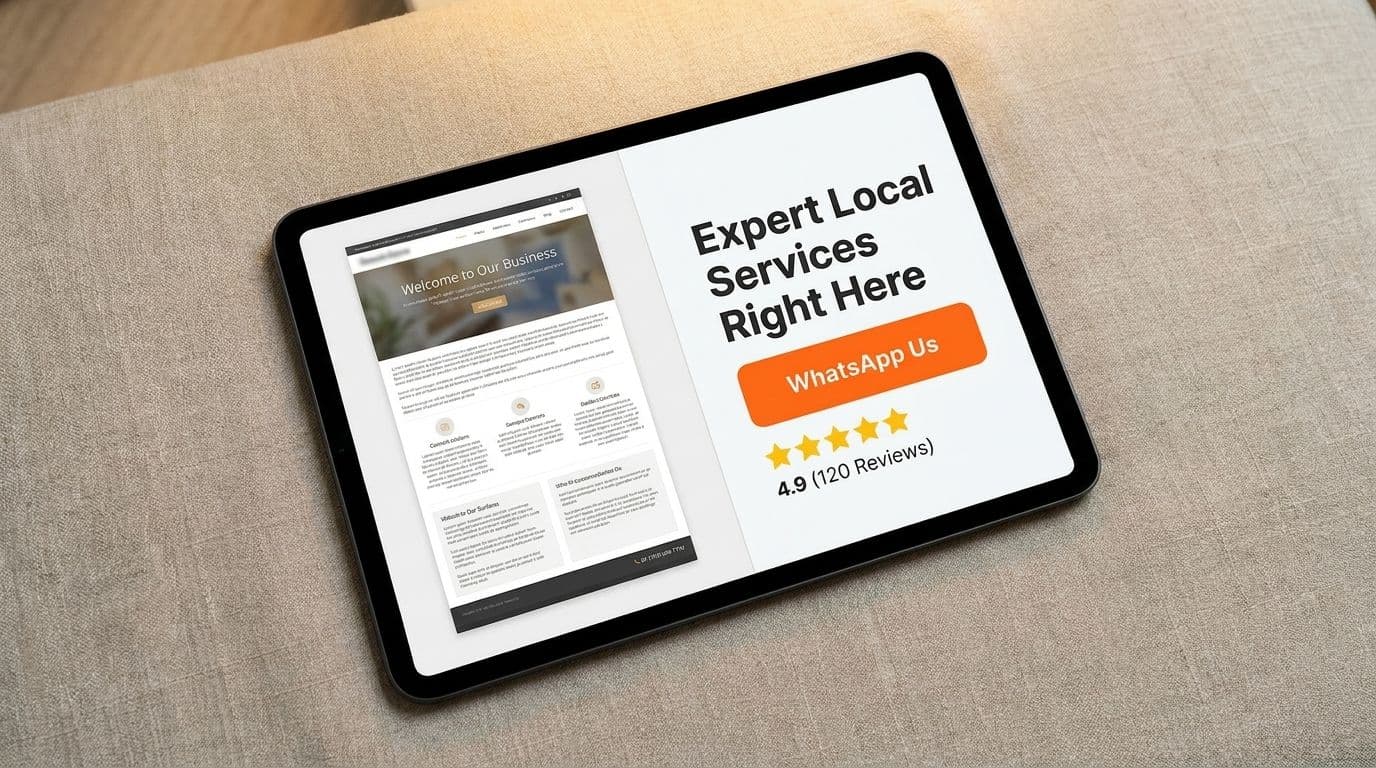
If you asked most local business owners what their website is for, they'd say something like 'so people can find us' or 'to look professional.' And while those are valid reasons to have a website, they're not the right goals. Your website's job is to convert visitors into enquiries — to take someone who found you online and turn them into someone who calls, messages, or books. Everything else is secondary.
The uncomfortable truth is that most local business websites fail at this job completely. They list services, show some photos, include a contact page, and then do nothing to actually move the visitor toward reaching out. The result: traffic that doesn't convert, marketing spend that doesn't pay off, and a website that exists but doesn't work. This post is about fixing that — with specific, actionable changes you can make to turn your website into a genuine enquiry-generating machine.
The 5-Second Test: What Does Your Homepage Communicate?
Open your website on your phone and look at what you can see without scrolling. That's what 70% of your visitors will see before they decide to stay or leave — because most of them are on mobile, and most of them make that decision in under 5 seconds. Ask yourself: does this immediately communicate what I do, who I do it for, where I'm located, and how to reach me? If the answer is no on any of those four points, you're losing visitors before they've had a chance to become customers.
- What you do: 'JEE and NEET Coaching for Class 11–12' not 'Welcome to Excel Academy'. Be specific. Generic welcome messages tell the visitor nothing.
- Who you do it for: Name your customer explicitly. 'For Class 9–12 students in Jaipur' or 'For small business owners in Rajasthan' tells the right visitor instantly that they're in the right place.
- Where you're located: Your city and area should be visible without scrolling. Local visitors want to know you're near them. It also helps Google rank you for local searches.
- How to reach you: A WhatsApp button or phone number should be visible in the top right corner of every page — including on mobile.
The Anatomy of a Local Business Website That Converts
Let's walk through the specific elements of a converting local business website — what they are, why they matter, and what to actually put in them.
- A specific, location-based headline: Not 'Your Trusted Partner in Education' — that could be anyone, anywhere. Try: 'Jaipur's Most Trusted JEE Coaching Center — Results Since 2015.' Specific, local, credibility-backed.
- A subheadline that names the benefit: Follow the headline with one sentence about what the customer gets: 'Small batches of 15 students, personalized mentorship, and a track record of 200+ selections in the past 3 years.'
- A primary CTA above the fold: One button, one action. 'WhatsApp Us' or 'Book a Free Demo Class' — before any scrolling is required. This should be styled in your brand's most visible colour.
- A social proof bar: 3–5 numbers that demonstrate credibility: '800+ students enrolled | 4.9 stars on Google | 200+ JEE selections | 8 years in Jaipur.' Put this directly below the headline.
- Individual pages for each service: A coaching center with separate pages for JEE, NEET, foundation, and board prep will rank for each of those terms individually. One page listing all services ranks for none of them.
- Testimonials on the services page — not just a testimonials page: Put 2–3 reviews directly above the enquiry button on each service page. This is where the decision is being made; that's where the social proof needs to be.
- A simple enquiry form with maximum 4 fields: Name, Phone, What you're looking for, Submit. Every additional field reduces completions. Never ask for email AND phone — pick one.
- A WhatsApp floating button: A sticky WhatsApp icon that follows the visitor as they scroll. It's the most tapped element on most local business websites.
- Your Google Maps embed: On the contact page, embed your Google map. It makes directions one tap away and signals to both visitors and Google that your location is legitimate and verified.
The Content That Actually Ranks and Converts
A converting website isn't just about design — it's about the words on the page. And most local business websites write content that's about themselves rather than content that serves their customer. Here's the difference.
- Write for your customer's search query, not for your ego: 'Best NEET coaching in Jaipur with small batches' is written for a customer searching for coaching. 'We are a premier educational institution dedicated to excellence' is written for no one.
- Include your city and neighbourhood name naturally throughout your content — not awkwardly stuffed, but wherever it's genuinely relevant: 'Our coaching center is located in Vaishali Nagar, Jaipur, easily accessible from Mansarovar and Civil Lines.'
- Address the customer's biggest concern on the page: If you're a coaching center, parents worry about whether their child will get individual attention. Address it directly: 'Our batches are capped at 15 students so every student gets direct attention from the faculty — not just the ones who raise their hand.'
- Use the exact language your customers use: If parents always ask 'how many students are in a batch?' — put that question and its answer on your homepage. If they always ask about fees — be transparent about your pricing or at least your price range. Avoiding the question doesn't build trust; answering it directly does.
Mobile Performance: The Non-Negotiable
Over 70% of local business website traffic comes from mobile devices. A website that looks good on a laptop but loads slowly or displays poorly on a phone is losing the majority of its visitors. Check your website's mobile performance right now using Google's free PageSpeed Insights tool (pagespeed.web.dev). Enter your URL and look at two numbers: the mobile performance score and the Largest Contentful Paint (LCP) time. If your LCP is above 3 seconds, you're losing a significant portion of visitors before they see anything.
- Compress all images before uploading — most local business websites load slowly because of uncompressed photos. Use a free tool like TinyPNG to reduce file sizes by 60–80% with no visible quality loss.
- Use a fast hosting provider — shared hosting from budget providers often results in slow server response times that no amount of optimization can fully fix.
- Avoid large video backgrounds or heavy animations on the homepage — they look impressive in design mockups and destroy mobile performance in reality.
- Test your website on an actual mid-range Android phone, not just a laptop browser. That's the device most of your local customers are using.
The Website Checklist for Local Businesses
- Specific, location-based headline visible without scrolling on mobile
- Phone number or WhatsApp link in the top-right header
- Primary CTA button above the fold
- Social proof numbers (reviews, students, years in business) near the top
- Separate page for each major service with location keyword in the page title
- Testimonials placed on service pages near the enquiry form
- Enquiry form with maximum 4 fields
- Floating WhatsApp button on all pages
- Google Maps embed on contact page
- Mobile load time under 3 seconds (check with PageSpeed Insights)
- Business name, address, and phone number consistent with Google Business Profile
- SSL certificate active (URL starts with https://)
If your current website hits 8 or more of these 12 checkpoints, you're in better shape than most local businesses in your city. If it hits fewer than 6, you're likely losing a significant portion of visitors who could have become customers. The good news is that these aren't expensive changes — most of them are content and structural decisions that any web developer can implement in a few hours. The impact on enquiries, however, is anything but small.
Related Posts
View all
MVP Development
How We Plan a Software Product From Idea to Launch
A transparent look at the modern software engineering lifecycle: discovery, technical architecture, agile sprint delivery, QA testing, and launch.
Read
Custom Software Development
Custom Software vs Off-the-Shelf Software: Which Should Your Business Choose?
Compare custom software development vs off-the-shelf SaaS. Total cost of ownership, operational fit, scalability, and decision framework.
Read